Back to blog
How Accurate Are Meal Plan Macros?
If you track your macros closely, you have probably wondered about meal plan macro accuracy — do the numbers shown in your app actually match what is on your plate? It’s a fair question, especially when those numbers are guiding decisions about your nutrition, training or health.
The calories, protein, carbohydrates and fat shown on a meal plan are not simply “found” in the finished meal. They are calculated or measured through a process, and the quality of that process determines how useful those numbers are.
The goal is not perfect precision down to the last gram. Food naturally varies. What matters is whether a provider uses reliable data, consistent portions, clear processes and regular checks to keep that variation under control.
In this article
- Where do macro numbers come from?
- How accurate should meal plan macros be?
- What makes macro numbers more reliable?
- Does lab testing make macros more accurate?
- What happens when a recipe changes?
- What this looks like at Calo
- Questions to ask a meal provider
- How to cross-check your own numbers
- Macro accuracy and food logging
- Frequently asked questions

Where do macro numbers come from?
There are a few common ways to build nutrition information.
The first is recipe calculation.
Each ingredient and its quantity is entered into a nutrition system using food-composition data. The system then calculates the calories, protein, carbohydrates, fat and other nutrients in the recipe and scales them to the serving size.
Databases such as USDA FoodData Central use data derived through chemical analysis, calculations and other validated approaches, so “database calculated” does not necessarily mean “guessed.”
The second method is laboratory analysis, where a food sample is tested to measure its nutritional composition.
Many food businesses use some combination of the two: recipe calculations for day-to-day nutrition information, with laboratory testing or other verification when additional confirmation is needed.
The important question is less:
“Do you use a database or a lab?”
and more:
“How do you make sure the numbers stay representative of the meal you actually serve?”
How accurate should meal plan macros be?
When thinking about meal plan macro accuracy, the goal should not be perfect sameness from one portion to the next.
Food is naturally variable. One chicken breast may contain slightly more fat than another. Vegetables vary by variety and season. Cooking changes water content. Portioning introduces another source of variation.
Nutrition-label regulations account for some of this, but there is no single universal percentage of error that applies to every nutrient in every country.
In the United States, for example, FDA compliance rules treat different nutrients differently. For calories, sugars, total fat, saturated fat, cholesterol and sodium, laboratory values generally cannot exceed the declared amount by more than 20%. Other nutrients have different requirements.
Saudi guidance also recognises accepted tolerance levels for nutrition declarations rather than assuming every measured value will match the label exactly.
So the useful standard is not perfect sameness.
It is whether the provider has a process that keeps variation controlled, notices meaningful discrepancies and corrects them.

What makes macro numbers more reliable?
Several things matter more than a provider simply saying its macros are “accurate.”
Reliable ingredient data
The calculation is only as good as the information going into it.
A generic database entry for “chicken breast” may not perfectly represent a specific supplier, cut or preparation method. Stronger systems use appropriate ingredient data, supplier specifications and verified values where available.
Accurate recipe quantities
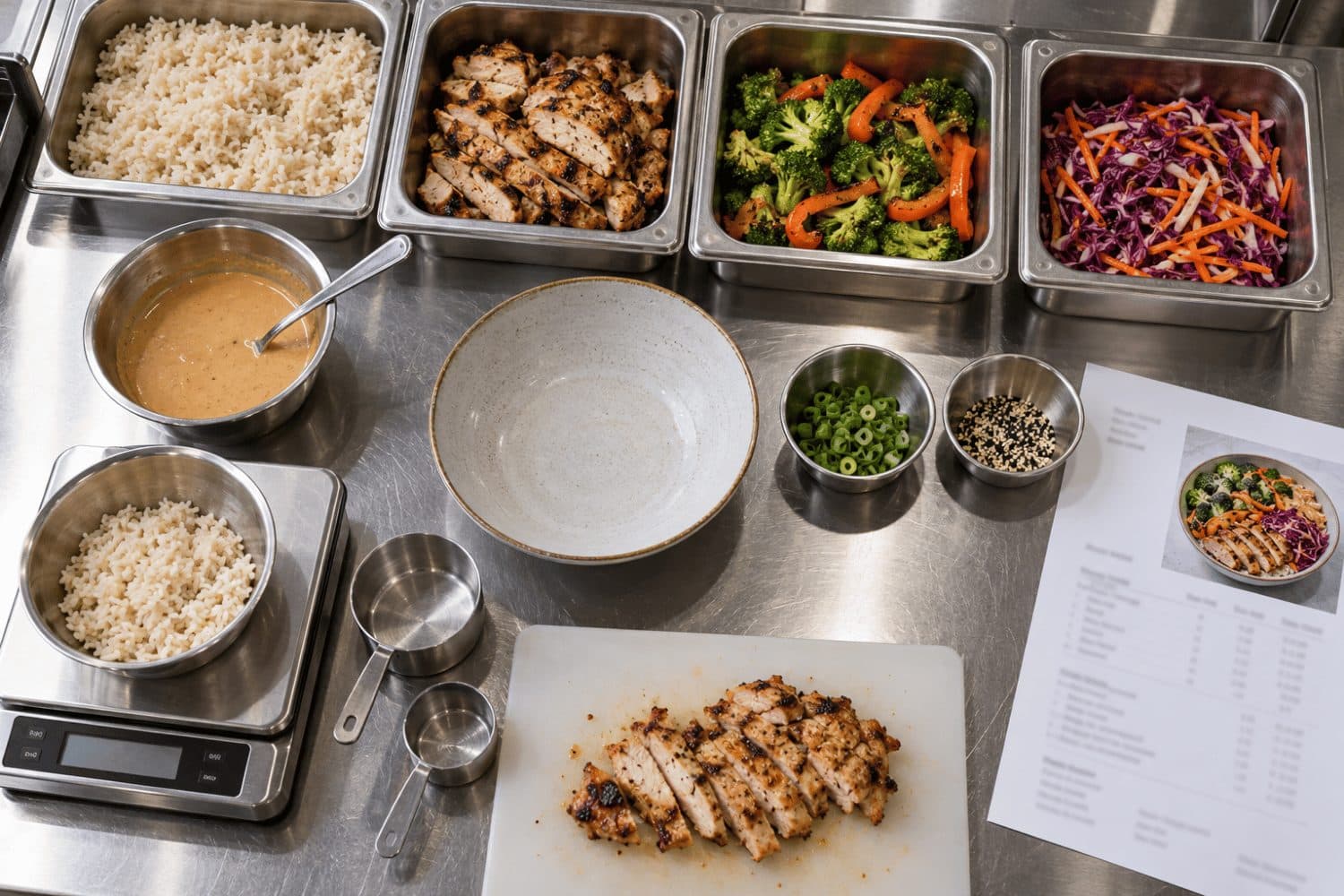
If the recipe says 120 grams of rice but the kitchen regularly serves 150 grams, the nutrition calculation may be perfectly correct for the recipe and still wrong for the meal in front of you.
That makes portion control just as important as the database itself.
Consistent cooking yields
Ingredients can gain or lose water during cooking.
Rice absorbs water. Meat loses moisture. Sauces reduce.
A reliable system needs to account for the quantities and yields actually used in production, rather than assuming raw and cooked weights are interchangeable.
Professional nutrition oversight
Dietitians and nutritionists can review ingredient data, recipe calculations and nutritional targets and identify values that do not make sense.
But credentials alone are not a guarantee of accuracy.
The stronger signal is professional oversight combined with a documented calculation and review process.
Regular verification
Ingredient specifications change. Suppliers change. Recipes evolve.
A provider should have a way to check whether the data in its system still reflects what is being purchased, prepared and portioned.
That may involve data audits, portion checks, supplier-document reviews or laboratory testing where appropriate.
Does lab testing make macros more accurate?
It can add another layer of verification, but it is not automatically more useful than every database calculation.
A laboratory analyses the specific sample it receives.
That can be valuable when verifying a finished meal or investigating a discrepancy. But one tested portion does not guarantee that every portion produced afterward will be identical.
Recipe calculation answers one question:
What should this meal contain based on its ingredients and quantities?
Laboratory analysis answers another:
What was measured in this particular sample?
Used together, they can provide different kinds of information.
The strongest system is not necessarily the one that sends every meal to a laboratory. It is the one that uses appropriate methods and knows when additional verification is needed.
What happens when a recipe changes?
This is one of the easiest ways for nutrition numbers to drift.
- A supplier changes the bread.
- A sauce formulation is updated.
- The kitchen increases a portion.
- A seasonal ingredient gets replaced.
If the nutrition information does not change with the recipe, the number in the app gradually stops representing the meal.
This is why version control matters.
A provider should be able to connect a nutrition calculation to a specific recipe version and update the calculation when an ingredient, quantity or serving size changes.
This sounds operational rather than nutritional, but it is one of the most important parts of keeping macro information useful.

What this looks like at Calo
At Calo, nutrition information starts with the ingredient data used to build each recipe.
The Nutrition team reviews nutritional information from ingredients and suppliers and cross-checks it against established food-composition databases. Where additional verification is needed, an ingredient or finished product may also be sent for laboratory analysis.
Once ingredient information is established, the quantities used in each recipe are used to calculate the nutrition values for the finished meal and serving size.
The process does not stop when a recipe enters the system. Ongoing checks are used to identify discrepancies and review changes so that the nutritional information can be updated when the ingredients or recipe change.
The principle is simple:
One calculation is not the finish line. Keeping the calculation aligned with what is actually being prepared is the important part.
Questions to ask a meal provider
You do not need to ask for a technical report.
A few simple questions tell you a lot:
- How are your calories and macros calculated?
- Who reviews the nutrition information?
- Do you use recipe calculations, laboratory testing or both?
- How do you account for portion sizes and cooking yields?
- What happens to the nutrition information when a recipe or supplier changes?
- How often do you check whether the numbers still match production?
A good answer should be specific enough that you understand the process.
“Trust us, our macros are accurate” is not much of an answer.
How to cross-check your own numbers
Before assuming the meal-plan calculation is wrong, look at the full picture.
Look beyond one meal
Coffee, sauces, snacks, drinks and meals outside your plan can make a meaningful difference to your total intake.
Watch the trend, not one day
Body weight moves for many reasons, including hydration, sodium, carbohydrate intake and digestion.
One unexpected weigh-in does not tell you whether the meal-plan macros are wrong.
Revisit your target
Your calorie and macro requirements are estimates too.
If your activity, body weight or routine has changed, the target that made sense several months ago may no longer be the right one.
Ask when something looks unusual
If a meal looks noticeably different from its stated nutrition information, ask the provider.
There may have been a recipe update, ingredient substitution or data issue worth checking.
Be more careful when the numbers have medical consequences
If you use carbohydrate or nutrition information to make treatment decisions, such as insulin dosing, meal-plan figures should not replace guidance from your healthcare team.
Precision matters differently when the consequence is medical rather than simply tracking fitness progress.
Macro accuracy and food logging
Even a carefully calculated meal plan only accounts for the food included in that plan.
Everything you add introduces another estimate.
Restaurant meals can vary considerably, and research has found substantial differences between stated and measured energy content in some individual restaurant foods, even when averages across a larger sample were fairly close.
Home cooking has similar challenges if portions and ingredients are not measured consistently.
That does not mean you need to weigh every bite.
If your goal requires closer tracking, consistency usually matters more than creating an illusion of perfect precision.
Keeping your additional meals and snacks relatively predictable makes it easier to understand the patterns in your overall intake.
Frequently asked questions
Are the macros and calorie counts on meal plans actually accurate?
They can be useful and reasonably representative when the provider uses reliable ingredient data, accurate recipe quantities, consistent portioning and a process for reviewing changes.
Some variation is normal because food itself varies.
The better question is whether that variation is being actively managed.
Why can the macros shown in an app sometimes look wrong?
Recipe changes, ingredient substitutions, incorrect data entries, serving-size changes, cooking yields and rounding can all contribute.
If a value looks materially different from what you would expect, it is reasonable to ask the provider to check the current recipe and nutrition data.
Is lab-tested nutrition information more accurate?
Laboratory analysis can be an important verification tool, but it represents the sample that was tested.
Recipe calculations and lab analysis serve different purposes, and neither eliminates the need for consistent preparation and portioning.
How much variation in macros is acceptable?
There is no universal percentage that applies everywhere.
Nutrition-label tolerances vary by market and by nutrient. Regulatory thresholds should also not be confused with a provider's internal accuracy target.
Does eating outside my meal plan affect macro tracking?
Yes.
The nutrition information for your plan only covers the food it provides. Meals, drinks and snacks outside it introduce additional estimates and variability.
If you want your tracking to be more useful, keeping those additions relatively consistent can make the overall picture easier to interpret.
Do HACCP or ISO 22000 certifications guarantee accurate macros?
No.
HACCP and ISO 22000 are designed around food-safety hazards and food-safety management, not verification of calories or macronutrients.
They may reflect a structured operational environment, but they should not be presented as proof that nutrition numbers are accurate.